That iron in him
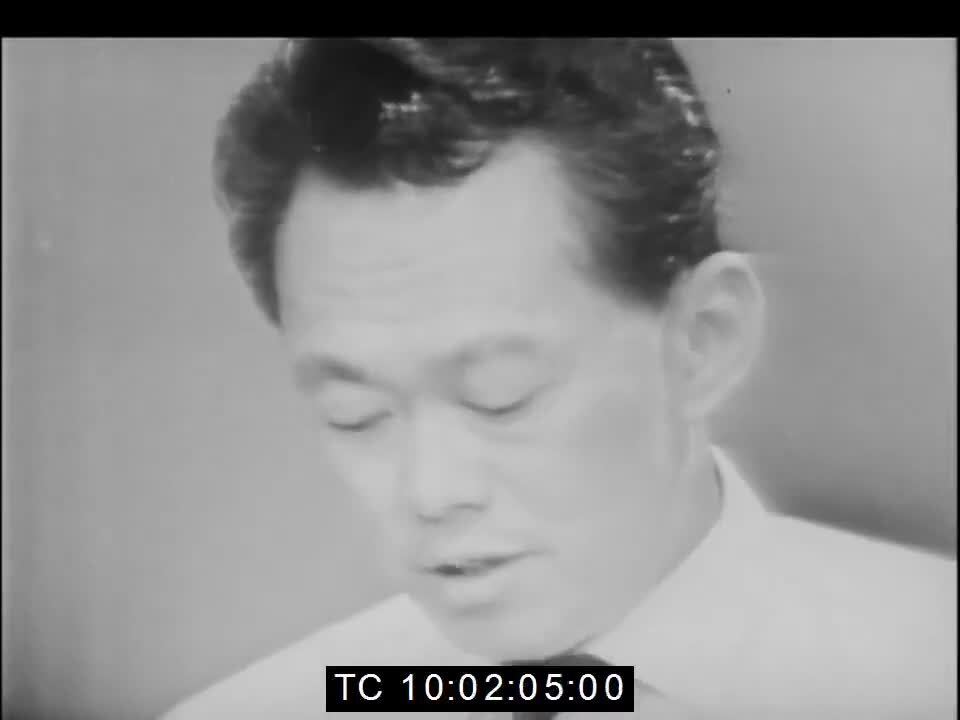
Lee Kuan Yew wrote that he'd never seen a book on how to build a nation out of a disparate collection of immigrants. So he built the country, and then wrote the book himself all those years later.
I read From Third World to First last year and it genuinely changed how I think about what's possible when a government decides to be competent. Singapore went from a port city with no natural resources and no hinterland to one of the wealthiest nations on earth within a single generation. Not through luck or oil money, but through radical pragmatism. Identify the problem, find what works, implement it, move on to the next one.
After finishing the book I went on a YouTube binge, watching old clips and interviews. The one that stuck with me most was the 1965 press conference where Lee announces Singapore's independence from Malaysia. You can see the anguish on his face. This wasn't a triumphant moment. It was a man realising that everything he'd planned for had just fallen apart, and that two million people were now his responsibility. He had to pivot from the vision he'd been working towards and figure out how to make a country survive on its own. That takes strong character.
What stayed with me was the principle underneath all of it: do the thing that works, not the thing that sounds impressive. And then keep doing it, problem after problem, for decades.
What I admire
The HDB system alone is remarkable. Ninety percent of Singaporeans own their homes through a public housing programme that actually works. Compare that to Britain, where housing policy has been broken for decades and homeownership is slipping further out of reach for anyone under forty. Singapore looked at the same problem and solved it.
The sovereign wealth fund. The infrastructure. The fact that the place just works, from the MRT to the hawker centres. There's a story about Lee Kuan Yew visiting London and observing how people bought newspapers from unattended stands, paying honestly and making their own change. He wanted to build that same kind of trust in Singapore. Whether or not the details are exact, the principle stuck with me: build systems that assume the best of people, and back it up with laws that hold everyone to it. It's both trusting and uncompromising, which is a combination most countries can't manage.
I love the hawker centre culture. The idea that incredible food should be affordable and communal, not exclusive. I love the work ethic, the directness, the lack of pretence about what it takes to maintain a small country surrounded by much larger neighbours.
Coming from Wales, where ambition often feels like something you're meant to apologise for, Singapore's attitude towards getting things done is refreshing.
The other side
I'm not naive about the trade-offs. The education system produces extraordinary results on paper, but it sounds crushing to live through. The pressure starts early and it doesn't let up. There's a cookie-cutter quality to the path: study, score, get placed, perform.
I read a Substack essay called If You Meet the Singaporean on the Road that was interesting because I knew every system has trade-offs, and this one laid them out in a way I hadn't seen before. The argument is that Singapore produces brilliant people who are exceptionally good at serving other people's visions but less practised at developing their own. The system teaches you not to be the one that gets cut. That's a rational response to the incentives, but it has a cost.
The essay frames Singapore as still fundamentally a service economy, where the smartest people work for external interests rather than building homegrown enterprises. It describes a cultural reluctance to be wrong in public, to express strong opinions, to back yourself. A risk-aversion baked in at the institutional level.
I found this perspective valuable precisely because I'm coming to Singapore full of admiration. It made me think harder about what that admiration was based on and what the trade-offs were.
The builder culture question
I'll be raising kids in Singapore, which makes the strength of its builder culture more than an abstract economic question for me. I'm making that choice with open eyes because the safety, the quality of life and the fact that the place functions at a level most countries can only aspire to are all real.
I want my kids to grow up believing they can build things, with the confidence to create their own systems as well as perform well within ones other people designed. That's something you have to actively cultivate if the surrounding culture doesn't default to it.
Singapore solved problems that most countries are still arguing about: housing, healthcare, safety and infrastructure. The same radical pragmatism that built all of this could make room for the messier, less predictable energy of people who want to build something new, giving them more confidence to risk being wrong and try anyway.
I think that's already starting to happen, and I want to be part of it.
Singapore is extraordinary in the factual, observable, look-at-what-this-place-has-done sense, rather than the polite way people say it at networking events. A tiny island with nothing became one of the safest, most functional and most prosperous places on earth within sixty years. I don't think people there hear that enough from the outside.
I want to contribute by building things that matter, raising kids who understand what makes the place special and adding whatever I can to a country that's already earned my respect from thousands of miles away. Coming from a small town in Wales, I don't think I'll ever take for granted the chance to make a life in a place that proves what's possible when people decide to get on with it.